Winds of Change
The contract and market failures reshaping the economic foundations of the clean energy transition

Wind power has been positioned as a cornerstone of the clean energy transition, offering vast resource potential, scalability, and, in many regions, a levelised cost of electricity (LCOE) that now undercuts fossil fuel generation. But beneath the surface, the economics of wind are proving more brittle than many expected. A wave of recent failures, contract renegotiations, and financial losses across global markets suggest that the business models underpinning the green transition may need urgent revision.
At the centre of this reckoning is the Power Purchase Agreement (PPA), a contract structure designed to stabilise revenues, unlock financing, and accelerate deployment. For over a decade, PPAs were considered the financial backbone of clean energy: long-term, fixed-price, and bankable. But in practice, they have often imposed rigid obligations on developers while offering limited flexibility in the face of volatility, whether in wind output, commodity markets, or geopolitical shocks.
This piece examines how those tensions are playing out. We begin with the collapse of Markbygden Ett, once Europe’s largest onshore wind farm and now a cautionary tale of PPA fragility. From there, we track the broader unravelling across Sweden’s wind sector, where a mix of meteorological miscalculations and financial inflexibility has wiped out over €1 billion in operator losses. We then widen the lens to Spain, the United States, India, Vietnam, and beyond, all of which show the same fault lines in renewable finance.
As with all industries, innovation in wind economics has and will continue to come from disruptive innovation. Business models are bending to accommodate a new energy reality: more variable, more decentralised, and more exposed to systemic shocks. From virtual PPAs (vPPAs) to collar contracts, from portfolio hedging to dynamic pricing, the next generation of renewable finance is already taking shape.
This evolution is not optional. Without more resilient contract structures, smarter grid integration, and honest reckoning with economic risk, the energy transition will remain vulnerable to precisely the instabilities it hopes to resolve.
The failure of Germany’s latest offshore wind tender in August 2025 - with bidders pointing to site constraints, onerous upfront cost requirements, and poorly structured contracts - is a timely reminder of the need for clear-eyed analysis in renewable energy financing and deployment. It follows a growing list of failed European tenders, underscoring that even mature markets are struggling to reconcile project economics with policy ambition. More detail can be found here.
Disclaimer: This is not a criticism made for criticism’s sake. I am a firm believer in the vital importance of the energy transition, and recognise that much of the current energy infrastructure is outdated and at risk of becoming stranded. However, if my time in academia taught me one thing, it is that critical reflection is paramount to achieving optimal outcomes. With that in mind, to facilitate the shift toward a sustainable future, we must have honest conversations about the shortcomings of renewables. Only through this transparency, debate, and critical reflection can we drive meaningful innovation and lasting change.
The PPA Model: From Cornerstone to Cracks
Power Purchase Agreements were designed as win-win instruments at the intersection of energy market liberalisation and climate financing. For electricity buyers, utilities or large industrial consumers, PPAs offer long-term price certainty and a predictable supply of energy, often from renewable sources that support decarbonisation objectives and regulatory compliance. For sellers, particularly renewable project developers, PPAs provide the financial foundation needed to secure future project financing. Long-term contracts reduce exposure to spot market volatility and enable developers to raise capital from banks and institutional investors by demonstrating stable, contracted cash flows.
Crucially, PPAs were designed to help resolve the classic mismatch in clean energy development: high up-front capital expenditures paired with long payback periods and variable generation. By locking in revenue through offtake agreements – a pre-arranged contract where the buyer agrees to purchase a specific quantity of energy before it’s produced – PPAs de-risk projects sufficiently to attract private capital at the scale required for development. They have also become important in markets where renewable subsidies are being phased out or replaced by market-based mechanisms, making them both a long-term financing tool and a policy lever for the energy transition.
In theory, everyone benefits. But, in practice, the fixed nature of these contracts can quickly become problematic when real-world volatility intrudes. Despite significant improvements in meteorological modelling, weather patterns do not follow spreadsheets. And price movements don’t always obey the most sophisticated forecasts. In both cases, George Box’s “all models are wrong, but some are useful” comes to mind. This is why an analysis of the recent history of PPAs and wind farm economics is so important.
Markbygden Ett’s PPA was hailed as something of a breakthrough. It secured a 19-year deal to supply Norsk Hydro with 1.65 terawatt-hours (TWh) of clean electricity annually. But the PPA was front-loaded with risk, which fell squarely on the operator’s shoulders.
The delivery requirements were fixed regardless of wind output, effectively treating a variable, weather-dependent asset as if it were a firm, dispatchable generator. This mismatch embedded a fundamental asymmetry. The operator was contractually obliged to deliver a constant volume of electricity each year, even though actual generation would inevitably fluctuate due to a mixture of wind variability, maintenance downtime, and seasonal conditions. Without built-in flexibility mechanisms – such as volume tolerance bands, balancing clauses, or shared curtailment risk – the project developer absorbed 100% of the operational variability internalising market risk exposure.
It should also be said that the agreed price was exceptionally low. It was reported at €25/MWh. This was far below the prevailing Swedish benchmark and European averages at the time. According to Bloomberg New Energy Finance (BNEF), the typical PPA price for onshore wind in Sweden during the early 2020s ranged from €55-65/MWh, with an average duration of 10 to 15 years, while averages across Western Europe hovered closer to €60-70/MWh (depending on contract length and project size). The steep discount was justified on the grounds of long-term revenue visibility and industrial proximity, but it left the project dangerously exposed to inflationary pressures and spot market surges. In hindsight, the 2019 PPA locked in a long-term price that bore little relation to the sharply rising marginal cost of electricity in a highly fraught geopolitical environment.
On paper, some of the logic behind the PPA was relatively sound: offer competitive clean energy to a huge regional industrial buyer, and secure stable (if lower given the price differential) returns over nearly two decades. But when the wind didn’t blow, Markbygden still had to deliver. With no storage capacity (certainly not utility-scale) and inflexible grid connections, the operator had no choice but to turn to the spot market to meet its contractual obligations. This meant purchasing electricity at whatever the prevailing market rate was, regardless of how high prices spiked.
In the wake of Russia’s invasion of Ukraine, electricity prices across Europe surged, driven by soaring natural gas prices and tightening supply. In some regions, prices exceeded €500/MWh during the peak stress period in mid-2022. To put that number into context, it was a twentyfold increase over the agreed €25/MWh PPA rate. With European electricity prices closely tied to natural gas prices, the economics of the Markbygden deal became increasingly untenable. Each unit of power purchased on the spot market to plug the generation gap was later sold at a substantial loss. The contract structure offered no relief valve, no pass-through mechanism (how changes in input costs are reflected in the final sale price of electricity produced), and no volume adjustment. The resulting mismatch between rising procurement costs and locked-in sale prices created a spiral of losses that would ultimately undermine the project’s financial model.
Fig. 1. Wholesale electricity prices in Europe (€/MWh).
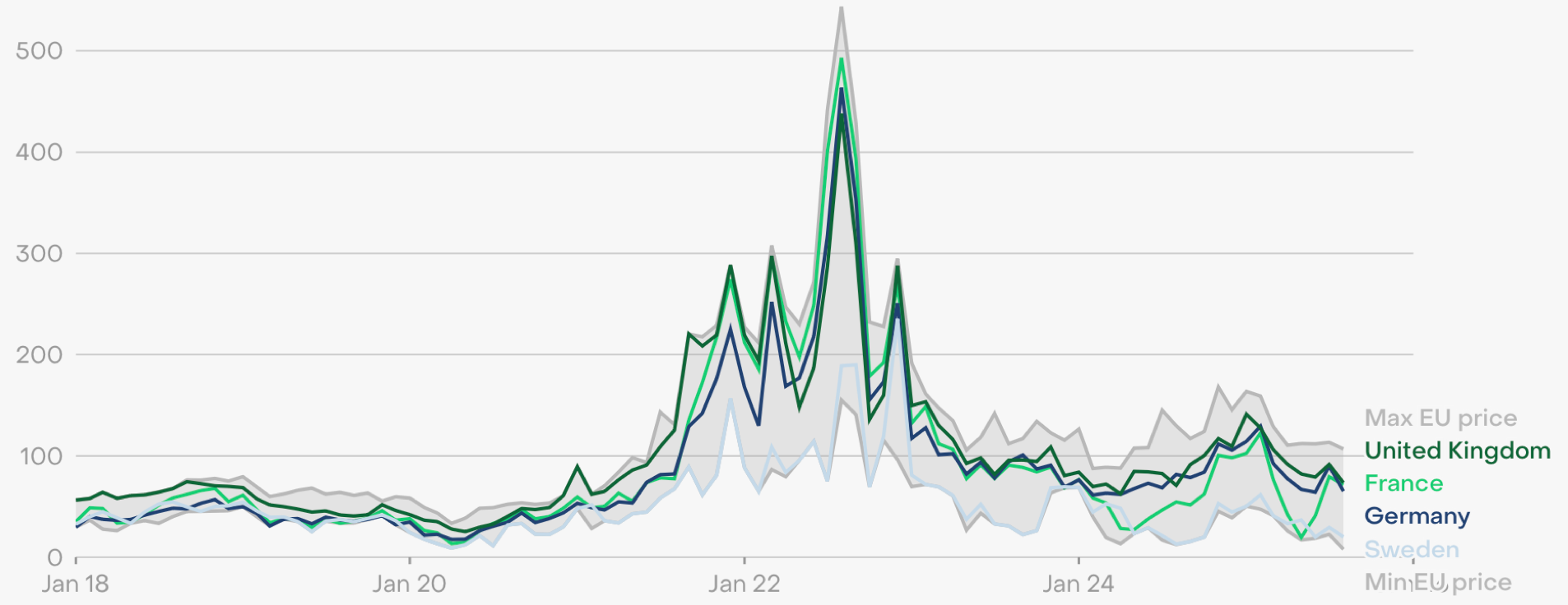
Source: ENTSO-e. Prices are average day-ahead spot prices per MWh sold monthly.
To mitigate front-loaded risks, renewable operators can opt to use financial hedges, including contracts for difference (CfDs) or market-based caps. These strategies, however, are not always viable for projects in smaller markets like Sweden, where liquidity in long-dated power derivatives can be thin. It should also be said that hedging tools are most effective when paired with contractual flexibility. A developer may hedge volume or price risk on the margin, but when a PPA locks in fixed volumes over extended duration without tolerance bands or reopener clauses (essentially a medium to renegotiate), the hedge itself cannot compensate for the scale of the deviation.
Despite improvements in climate modelling, weather risk remains inherently difficult to hedge beyond seasonal averages. Moreover, the cost of hedging typically increases in stressed market conditions – precisely when it’s most needed – creating a further mismatch between theoretical risk management and real-world resilience. In the case of Markbygden Ett, the lack of integrated hedging mechanisms within the PPA framework – alongside heavily discounted pricing, relative to pre-Ukraine crisis levels – left the operator fully exposed when energy markets spiked.
Markbygden Ett: Europe’s Green Showcase Turned Cautionary Tale
Intended to generate the equivalent of 8% of Sweden’s power consumption, Markbygden Ett came online in 2019, part of a sprawling complex in northern Sweden backed initially by Macquarie’s CIG arm and GE Energy Financial Services. With nearly 200 turbines and 650 megawatts (MW) of installed capacity, the total cost of the project was meant to be €800 million. A year later, Chinese state-owned CGN took control of the project. With top-tier, institutional financing, and the backing of major industrial offtakers, Markbygden served as the blueprint for future European green energy development. But within six years it faced insolvency.
The project ran into difficulties almost from the outset. Despite favourable wind mapping and meteorological support, it struggled to meet its generation targets. It began delivering contracted electricity in 2021, two years after the PPA was signed. No sooner had it started delivering electricity did it run into financial difficulties. Even before the Ukraine crisis, financial losses had accumulated to the tune of €24 million.
Then came the major shock. Russia’s invasion of Ukraine in February 2022 upended energy markets. The operator was unable to deliver on a constant basis the 1.65TWh it had promised to supply each year. The shortfall had to be made up by paying exorbitantly high prices for electricity on the spot market.
The fallout?
· By 2023, losses had risen 7.3x compared to 2021 levels. At €175 million, losses were equal to 22% of the initial project cost just two years after it began supplying electricity.
· A re-structuring plan was reached by late 2024.
· The PPA was cancelled.
· Norsk Hydro, the original buyer, claimed €248 million in compensation (roughly one-third of the project cost).
The fallout from the PPA cancellation wasn’t confined to the project operator and investors. For Norsk Hydro the loss of contracted clean power created both a commercial and reputational headache. In the absence of a ready substitute, it was forced to rely more heavily on grid-sourced electricity, which, during periods of high demand (as was the case during the Ukraine crisis), or reduced renewables output, can still draw on fossil-based generation. While Norsk Hydro has since diversified its offtake strategy and signed new renewable PPAs, the episode highlights a noteworthy paradox: failed clean energy contracts do not just destroy capital; they also set back decarbonisation and transition objectives within the wider system.
A Systemic Issue: Sweden’s Wind Sector Woes
Markbygden Ett was not an outlier. Across Sweden, other wind farm operators faced similar obstacles and fates.
But, before we get onto the subject of Sweden’s systemic challenges, you might reasonably ask: why Sweden? The answer lies in its utility as a representative case study. Over the previous 10 years, Swedish onshore wind farms have witnessed the largest growth in installed capacity, rising from 14.2% of total installed capacity (the lowest of all forms) in 2016 to 34.0% by 2025 (the largest, surpassing hydro). The resilience of the country’s energy infrastructure is therefore considerably reliant upon the success of this growing installed wind capacity.
Fig. 2. Installed capacity by product type (MW, % of total), Sweden.

Source: ENTSO-e.
Aldermyrberget, a 72 MW project located in Vasterbotten, just south of Markbygden, signed a 15-year PPA with mining firm Boliden AB. Construction began in 2019, becoming fully operational in 2022. Consisting of 17 Vestas V150 turbines, the delivery schedule was fixed at 31.3 MW during winter and 22.7 MW in the summer months (at fixed prices), but actual generation fell short of contractual obligations. Like Markbygden, the operator was forced to cover shortfalls through the open market. Just one year after becoming fully operational, the project owners announced that the project had suffered losses of SEK 144 million (€12.7 million). Attempts to renegotiate the PPA were rebuffed, leading to termination in January 2024.
While the total cost of the Aldermyrberget project remains undisclosed, we can estimate costs and losses using industry benchmarks. The project had a nameplate capacity of approximately 72 MW. With onshore wind capital costs typically ranging from €1.3 million to €2.2 million per MW installed, applying a median rate of €1.75 million per MW implies a project cost closer to €125 million. At the upper bound (€2 million/MW), costs could have been as high as €140–145 million. Taking the median cost estimate, reported losses of €12.7 million represent roughly 10% of the total project cost. However, the picture worsens when factoring in compensation payouts to Boliden. Although the exact amount remains undisclosed, the miner reportedly demanded close to €60 million, while the operator suggested around €5 million. Using the midpoint of these figures, total losses including payouts rise to approximately €45 million, or nearly 37% of the median estimated project cost. Regardless of the precise numbers, these losses, combined with compensation and sunk costs, underscore the significant financial strain placed on projects operating under PPA tolling arrangements during volatile market conditions.
Markbygden Ett was not Norsk Hydro’s only stroke of bad luck when it came to seeking out a reliable source of wind-generated electricity. The Overturingen project, located further south, set out similarly unrealistic production quotas and fixed prices. It was also a relatively large project with a reported installed capacity of 241MW. Assuming a median project cost of €1.75 million per MW installed would put the cost at €422 million. Wind deficits led to the operator producing 15% less electricity than anticipated, forcing it to plug the gap with purchases via the open market. It’s the same story as Markbygden and Aldermyrberget. While exact losses have not been disclosed, the scale of the underperformance – due to locked-in contractual volumes, elevated spot prices, and compensation – likely drove significant unreported financial stress prior to restructuring.
The deeper issue, as economists Christian Sandström and Christian Steinbeck have shown in their 2024 study (found here), is that Sweden’s wind project difficulties appear structural. Between 2017 and 2022, Swedish wind operators racked up a staggering €1.2 billion in losses. This is equivalent to 20-25% of the country’s annual wind market value. Across the sector, loss margins ranged from 19% to an eyewatering 90% of revenues. These were not isolated underperformers, but systemic outcomes across a range of operators and asset sizes.
What makes these figures more striking is that they occurred despite a largely favourable policy environment. Developers benefitted from generous government subsidies, access to electricity certificates, and exemptions from grid upgrade costs and property depreciation expenses – advantages that should, in theory, have tilted the economics decisively toward profitability. And yet, consistent returns remained elusive.
Even large-scale wind farms, which, ostensibly, benefit from economies of scale and operational efficiencies, posted some of the largest losses in the sector. Rather than scale reducing marginal costs, it often magnified financial exposure, especially in those cases where PPAs were inflexible and wind conditions overestimated.
Unsurprisingly, these underwhelming returns began to erode investor confidence, particularly among sources of foreign capital. Many began to question the robustness of the climate and financial modelling that had underpinned project site selection and output forecasts (precisely what we have seen with Germany’s failed offshore auction this month). The Swedish Energy Agency’s wind mapping – once considered authoritative – proved to be poor predictors of actual generation. They failed to account for mounting climate variability, shifting weather patterns, and microclimate effects. What looked bankable in 2017, given standardised meteorological projections, looked reckless by 2022 in the face of repeated underperformance and extreme market conditions.
The spike in natural gas prices during the Ukraine crisis should serve as a powerful reminder of why transitioning away from fossil-based energy is so critical. Not just for climate goals, but for economic resilience. A systems-thinking approach tells us that these objectives are far from mutually exclusive. Critically, the crisis exposed a structural vulnerability. In many European electricity markets, power prices remain tightly coupled to gas through marginal pricing systems. This means that even renewable generators – whose costs are unrelated to fuel inputs – can see their revenues and risks shaped by gas volatility. A successful transition will therefore require not just replacing gas generation, but decoupling electricity prices from gas altogether. Without that, clean energy investments will continue to carry fossil-linked risks they were supposed to eliminate.
The Renewable Energy Paradox
At the heart of the problem is a paradox familiar to any student of supply and demand, but one that behaves in unconventional ways under the economics of renewable energy.
When the wind doesn’t blow, electricity generation declines, just as demand remains steady or even rises. The result is a sharp increase in electricity prices. But for wind operators locked into fixed price and fixed-volume delivery contracts this textbook price spike becomes a liability, not a benefit. If the turbines aren’t producing, operators must purchase electricity on the sport market – often at elevated prices as demand rises due to other operators plugging shortfalls – to fulfil their PPA obligations, often incurring steep financial losses.
When the wind does blow, the situation flips. Supply surges, but because electricity must be consumed in real time, excess generation floods the market. If demand remains inelastic in the short term, this oversupply can lead to price depreciation, sometimes into negative territory.
In theory, a fixed-price PPA should protect operators from such market volatility, ensuring a guaranteed revenue stream even when spot prices decline. But in practice, that protection is often incomplete. If generation exceeds contracted volumes, or if output falls outside specified delivery windows, surplus electricity can still be dumped into the market at prevailing (and sometimes negative) prices.
Grid congestion and curtailment add an additional complication. When transmission constraints arise, operators can be forced to shut-down turbines entirely, generating zero revenue. The result is a system where operators generate power, but the economics deteriorate. Here we need to contrast this with fossil-based fuel generators, who can throttle output or adjust input costs; wind operators have no control over supply. They are price takers twice over: once from the variability of climatic conditions, and again from the volatility of energy markets.
This asymmetry undermines the assumptions that typically underpin infrastructure modelling and financial decisions, namely, that stable cash flows and controllable inputs can support long-duration contracts and leveraged capital structures. The paradox becomes particularly acute in energy-only markets like Nord Pool, where revenues depend on spot prices and balancing costs incurred during scarcity events are borne by electricity generators.
Recent research by the International Energy Agency and think tanks such as Ember and Rystad Energy (hereand here) confirm the severity of this challenge. In 2024, Europe recorded more than 4,800 hours of zero or negative-day ahead electricity prices, nearly double the previous year. That equates to 200 full days of negative pricing in a single year (albeit this was non-contiguous). In wind-saturated markets like Germany and Denmark, producers were forced to pay to feed electricity into the grid. At the other extreme, during supply shocks, peak prices can rise more than tenfold, revealing just how poorly suited intermittent generation is to systems lacking real-time flexibility or price-responsive demand.
Fig. 3. Number of negative price hours & average depth of negative prices in Europe.
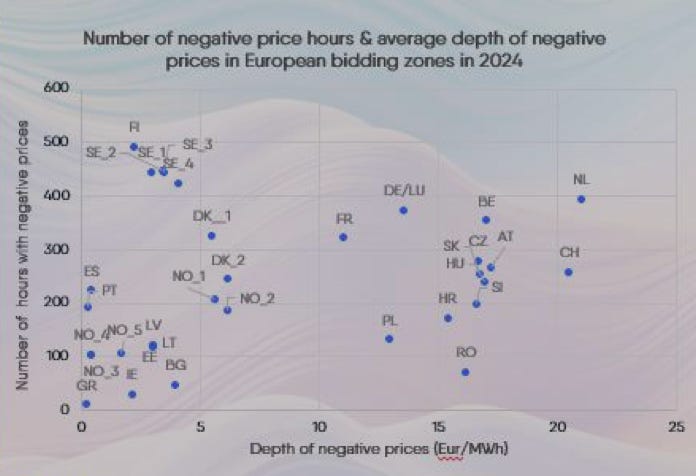
Source: Eurelectric. Note: the farther right and higher a country appears, the more frequent and severe its negative prices.
Ultimately, this dynamic is economically destabilising. It erodes investor confidence, complicates project bankability, and places additional strain on grid infrastructure that is, in many places, already outdated. Without major structural interventions — from utility-scale storage and real-time grid balancing to market reform and redesigned PPAs — the paradox will continue to undermine the economic case for large-scale wind deployment. Investors, after all, expect returns that exceed the cost of capital. If that equation breaks down, the long-term capital financing required for the transition could flee. As more electricity systems approach high penetration rates for variable renewables, the stakes will only grow. What’s at risk is not just profitability, but the pace and credibility of the transition itself.
Global Echoes of the Same Fault Lines
Sweden’s wind sector challenges may have been a warning shot, but they were far from unique. Around the globe, long-tenor, fixed-price PPAs – once considered the gold standard for clean energy financing – have revealed deeper structural fragilities. From the US to Vietnam, a common pattern has emerged. Poorly calibrated contracts, with unhedged exposure to market volatility, supply chain shocks, grid instability, or shifting political winds, have failed when placed under pressure.
It's worth saying here that the challenges presented by fixed PPAs are not confined to the wind sector. Below, we sketch out some examples over PPA failures across different renewable sources.
United States: Avangrid’s Offshore Wind PPA Collapse
In 2023, Avangrid cancelled two flagship offshore wind contracts – Commonwealth Wind and Park City Wind – with Massachusetts and Connecticut utilities. The deals, originally priced at ~$80/MWh, became economically unviable amid inflationary pressures, the Fed’s rate hiking cycle, and ballooning equipment costs. Avangrid paid over $60 million in breakup fees, setting off a wave of renegotiation efforts across the US offshore wind sector. The silver lining is that Avangrid’s case looks to have been something of a turning point, with developers pushing for inflation-linked contracts and shorter durations.
California: EDF-SCPPA Solar + Storage Contract Falls Apart
In April 2025, EDF Renewables exited a major solar-plus-storage deal with the Southern California Public Power Authority (SCPPA), after construction cost estimates exceeded agreed thresholds. The fixed-price contract offered no room to adjust for escalating capital expenditures or storage integration delays. SCPPA refused to renegotiate, and the project collapsed without legal ramifications, but also, without electricity delivery. The case raised fresh questions about contract rigidity in volatile inflationary environments, particularly for capital-intensive storage-enabled projects.
Spain: Grid Stability Forces Curtailment
An unseasonable blackout in April 2025 forced Spanish grid operators to curtail hundreds of megawatts of wind and solar generation, exposing a lack of clarity in force majeure clauses embedded in many PPAs. In this case, it wasn’t clear what constituted force majeure, nor how curtailments were to be treated. This happened because the grid was unable to absorb all the electricity being produced. In cases like these renewable sources are often the first to be curtailed given their variability, and in many systems, lack priority dispatch rights. Simultaneously, persistent negative pricing, driven by midday solar oversupply, contributed to a broader depletion of revenues for operators across Spain. In several regions, developers reported earnings 25-40% below PPA projections, prompting calls for flexible formulas or capacity-based remuneration.
India: Political Risk and Regulatory Drift
India’s PPA landscape remains highly volatile. In 2025, over 40 GW of renewable capacity sits in limbo, awaiting finalised offtake agreements from state-owned distributors. Meanwhile, prior attempts by states like Andhra Pradesh to renegotiate signed PPAs – sometimes retroactively – have diminished investor confidence. Developers point to rising payment delays, tariff uncertainty, and inconsistent regulatory enforcement as growing risks. For foreign investors, the contractual environment is now a greater risk than the underlying project economics.
Vietnam: Contract Retroactivity and Investor Exodus
This year, Vietnam’s state utility, EVN, shocked markets by retroactively adjusting feed-in tariff payments for over 170 solar and wind projects. Citing procedural issues in documentation, EVN slashed payouts by 20-30%, amounting to an estimated $13 billion in losses across the investor base. Multiple international developers, including those backed by European and Japanese funds, have since ended new commitments in Vietnam. The episode underscores how even well-subsidised markets can quickly unravel without effective legal safeguards.
What unites these cases is not geography, technology, or developer profile, but a shared vulnerability to volatility. PPAs that fail to anticipate and safeguard against price dislocations, weather variability, construction risk, or political interference are proving brittle when placed under stress. The consequences go far beyond missed earnings. In many cases they have diminished investor confidence and spurred capital flight from entire markets.
If the PPA is to remain the backbone of clean energy finance, it must evolve from a static guarantee into a dynamic risk sharing tool, one that reflects the complexity of modern energy systems and the current economic realities of the transition.
Reform on the Horizon: The Future of PPAs
The fallout from these cases is forcing a broader much needed rethink of how renewable energy is contracted and financed.
Utilities and large industrial customers are already shifting strategy. The old model of large, long-tenor PPAs, covering most or all the requirement output for 15-20 years, is giving way to shorter, more flexible agreements. Buyers increasingly prefer to spread exposure across multiple counterparties, hedge smaller volumes, and embed clauses that allow for periodic price renegotiation or delivery adjustments.
At the policy level, the European Commission’s Draghi Report (2024) reaffirmed the importance of PPAs in mobilising capital for the energy transition, but stressed the need for reform. It called for contract structures that better reflect a world of volatile prices, changing demand profiles, and rising uncertainty around generation patterns.
Financial institutions are adapting as well. Where once banks and institutional investors required offtake contracts to underwrite project loans, lenders are now developing new credit assessment models to support more dynamic offtake structures. Collateral requirements are being recalibrated, and hedging strategies are becoming more sophisticated. Insurance products are also emerging to cover downside risks such as weather-related generation shortfalls, delivery failures, or extreme spot price dislocations.
Some of the most notable innovations are coming from the private sector itself.
Iberdrola, one of the world’s largest renewable energy developers, has moved toward hybrid PPA structures that combine elements of physical delivery and merchant exposure. In some projects, it now layers in battery storage or sells only a partial share of output through long-term contracts, retaining upside optionality.
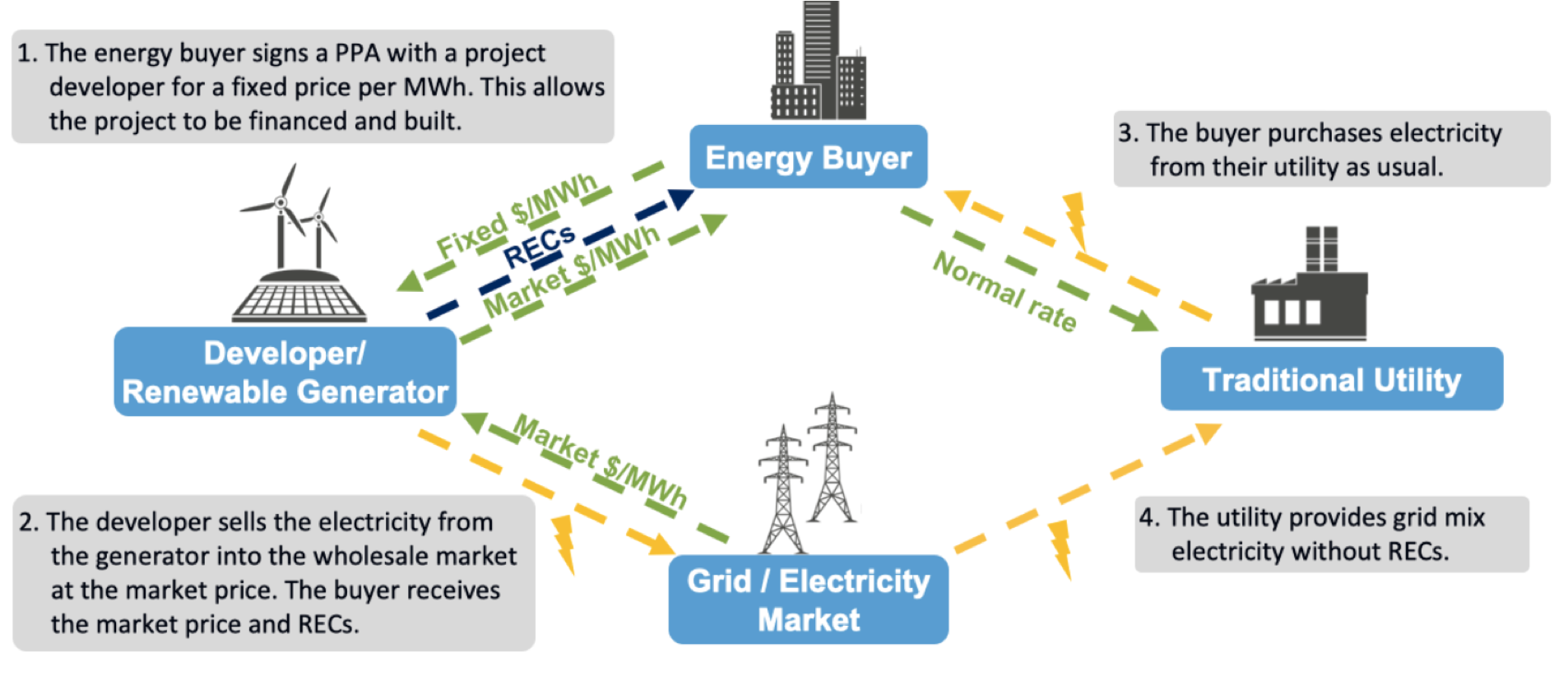
Tech giants like Google and Microsoft have pioneered the use of virtual Power Purchase Agreements (vPPAs), financial contracts that guarantee a fixed price for renewable electricity without requiring physical delivery. Instead, power is sold into the grid at market rates, and the buyer settles the financial difference relative to a pre-agreed benchmark. This structure allows corporates to support clean energy projects in diverse locations, earn renewable energy credits (RECs), and hedge against price volatility, all while avoiding the constraints of direct grid interconnection.
Virtual PPAs have become increasingly popular, but their share of overall PPAs remains relatively small at 15-20% (estimates vary). In Europe, vPPA adoption grew from around 7% in 2021–22 to over 17% by 2025. The US remains the largest market, with a 2024 market value of $13.4 billion, ahead of Europe ($8.9 billion) and Asia-Pacific ($4.2 billion).
Fig. 4. Overview of the vPPA model
The durability of this trend, particularly in the States, will depend heavily on federal energy policy, if in a somewhat roundabout way. Trump-era tariff hikes and clean energy program rollbacks have pushed PPA prices higher, injecting uncertainty into project pipelines. In response, developers and buyers alike have leaned into more flexible contracting structures, including vPPAs, that can accommodate delays, cost escalations, and shifting subsidy regimes. Paradoxically, these policy headwinds have accelerated innovation. Distributed models, including behind-the-meter renewables and aggregated DER-based vPPAs, are gaining ground. Developers like Engie have reported robust activity, with 1.5 GW of vPPAs signed in the US in 2024 alone, in what looks to be a sign of greater market resilience and structural change.
In the United States, NextEra Energy has pioneered the use of multi-tiered Power Purchase Agreements that incorporate both strike price floors and ceilings, effectively creating a collar contract structure. Under this model, the buyer agrees to pay a fixed price so long as market prices remain within a pre-agreed band. If the price falls below the floor, the buyer compensates the seller to cover the shortfall. If prices rise above the ceiling, the seller refunds the excess gains. This mechanism limits downside risk for developers while capping upside exposure for buyers, enabling a more symmetric distribution of price volatility. As macro uncertainty increases, this kind of flexibility is becoming the template for the next generation of long-term clean energy contracts.
Although a marked (and welcome) improvement on the traditional PPA, vPPAs and other more flexible contracts are not without shortfalls. One of the most significant is “basis risk”, the mismatch between the local price, where a project sells its electricity, and the regional hub price used for financial settlement. During periods of congestion or price divergence this can lead to unexpected losses or diminished returns for the buyer. Market risk is also present. When wholesale prices fall below the strike price range in the contract, buyers may end up overpaying when a renewable project underdelivers, leaving the buyer short of the renewable energy credits (RECs) required to substantiate sustainability claims.
Beyond market mechanics, counterparty risk and reputational risk warrant attention. Many vPPAs are signed with special-purpose vehicles (SPVs) that operate on tight margins, making them more vulnerable to financial distress and potentially default in changing macro environments. And because vPPAs typically involve no physical delivery to the buyer, sceptics have argued that these contracts help corporates to greenwash. The argument goes that companies may claim 100% renewable usage via vPPAs, while still drawing conventional grid power for operations. Not dissimilar to how corporates purchase carbon credits that safeguard a natural asset at no risk of destruction. These risks should not negate the value of vPPAs, but they do highlight the importance of thoughtful contract structuring, robust due diligence, and transparency. As the market matures, these issues will increasingly shape both investor scrutiny and regulatory frameworks.
Winds of Change
Markbygden Ett was never meant to fail. It was built as a beacon of Europe’s clean energy future. But its collapse wasn’t just a project-specific misstep. It revealed something deeper: the clean energy transition is not only a technological challenge, but a financial one. What cracked in Sweden wasn’t the viability of wind power, it was the rigidity of its economic scaffolding.
At the heart of that rigidity sat the PPA. Once hailed as the financial backbone of renewable energy, the traditional fixed-price, long-tenor PPA is showing its age. Volatile weather, shifting geopolitics, inflation, and grid inflexibility have exposed just how brittle these contracts can be. And yet, in that brittleness lies the seed of evolution. Like any period of disruptive innovation, early failures are not the end. They’re part of an essential feedback loop that enables smarter design.
From the US to Vietnam, Spain to India, the past few years have seen a sharp pivot: from orthodoxy to flexibility, from single-buyer offtakes to portfolio hedging, from static strike prices to dynamic risk-sharing agreements. The rise of virtual PPAs, collar contracts, and multi-party frameworks reflect a growing recognition that financial tools must adapt to the intermittent, decentralised, and increasingly politicised nature of modern energy.
This is more than contract innovation. It's a reframing of what sustainability means. Environmental responsibility is not enough. To attract and retain capital at scale, clean energy must also be economically resilient. That means building agreements that accommodate uncertainty, absorb volatility, and align incentives across developers, buyers, financiers, and grid operators.
We are leaving behind the era of rigid guarantees and entering one shaped by probabilistic thinking, adaptive mechanisms, and shared risk. The future of clean energy financing will be shaped not by avoiding disruption, but by harnessing it, building agreements that are as dynamic and adaptive as the resources they support.